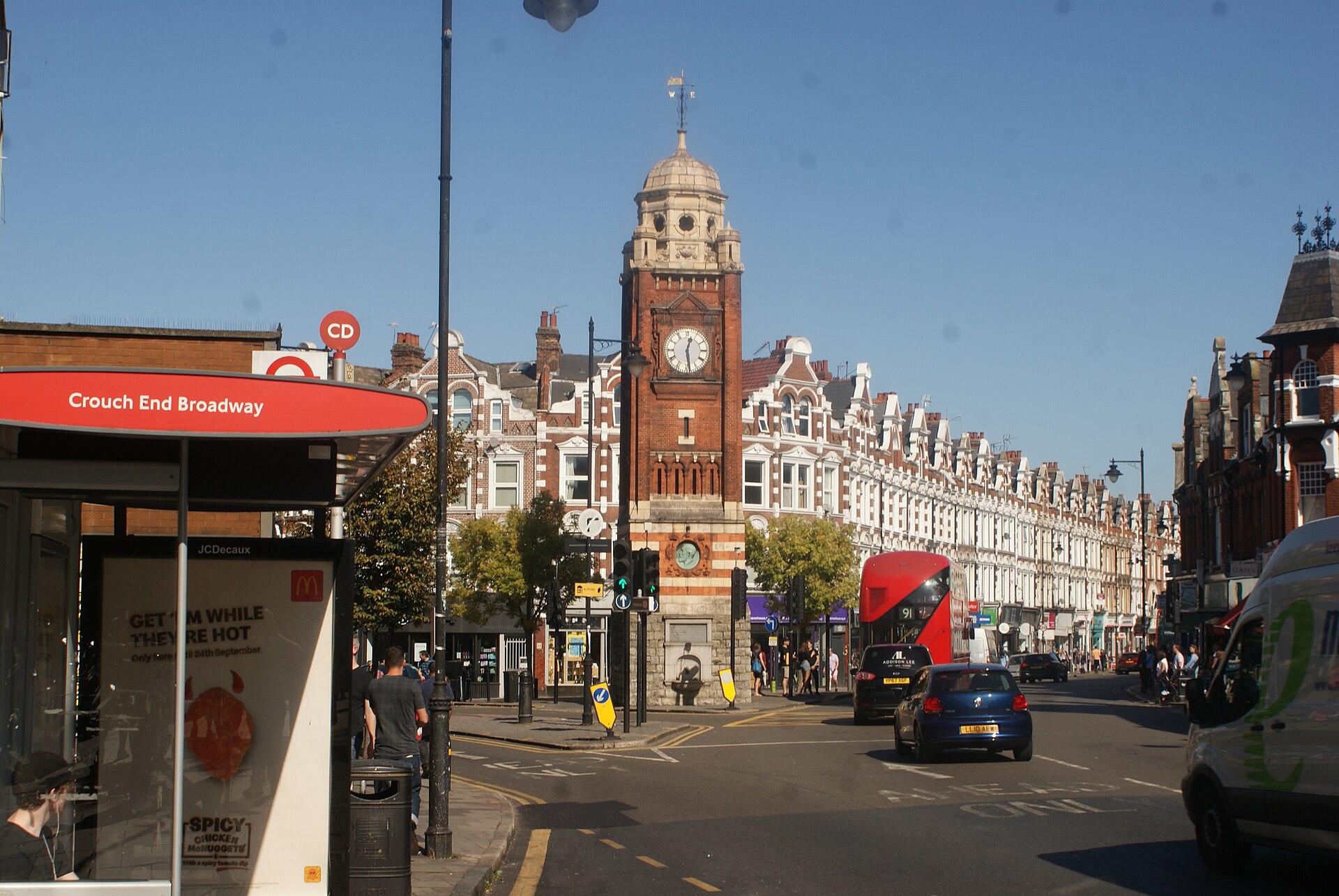
The woods are the real memorial. The tower is the receipt.
Most people in Crouch End use the clock tower as a direction rather than a monument: the thing you meet at, the point where the Broadway divides into Park Road and Tottenham Lane. Almost nobody looks at the bronze head set into it.
It is Henry Reader Williams (1822–97), and the tower was put up in 1895 "in appreciation and recognition of the public services" of the man who chaired Hornsey's local authority from 1880 to 1894, according to the Hornsey Historical Society. His most durable achievement is not on the Broadway at all. Williams campaigned against developers to preserve Highgate Wood and Queen's Wood — which is to say that the woods people walk in on a Sunday are the real memorial, and the tower is the receipt.
The money came fast. Of an estimated cost of £1,200, £900 was raised by public subscription in the first three weeks, and the tower was unveiled on 23 June 1895. It was designed by the architect Frederick Knight and built by a Highgate builder, J. W. Dixon. The most distinguished name attached to it was the sculptor Alfred Gilbert, who made the bronze portrait head.
The site had form before any of that: a wooden cross is thought to have stood there, perhaps the origin of the name Crouch End.
Its later career was less exalted. In 1936 public conveniences were built in the basement. They closed in the 1990s, and the drinking fountain has not worked for years. The tower is Grade II listed.
The renewed attention follows a piece by the Hornsey Historical Society member Janet Owen, published in the Ham & High on 30 August, on Williams and the tower's origins.
- The clock tower was erected in 1895 to honour Henry Reader Williams (1822–97), chairman of Hornsey's local authority 1880–1894.
- Williams campaigned to preserve Highgate Wood and Queen's Wood against development.
- £900 of an estimated £1,200 cost was raised by public subscription within three weeks; the tower was unveiled on 23 June 1895.
- Designed by architect Frederick Knight, built by Highgate builder J. W. Dixon; bronze portrait head by sculptor Alfred Gilbert.
- The tower sits where Crouch End Broadway splits into Park Road and Tottenham Lane, possibly the site of an old wooden cross.
- Public conveniences operated in the tower's basement from 1936 until the 1990s.
- The tower holds Grade II listed status, dated to its 1895 unveiling.
Every factual claim in this story is linked to the evidence behind it. Where the newsroom has added judgement or framing, it is listed separately. Sources accessed 5 September 2026.
- A Brief History of the Crouch End Clock Tower (community)
- Crouch End Clock Tower - Art UK (dataset)
- Meet the man honoured by Crouch End's landmark clock tower (media)
- Urbanisation of Hornsey - Hornsey Historical Society (community)
Claim by claim (8 facts, 7 editorial judgements)
- The tower was erected in 1895 'in appreciation and recognition of the public services' of Henry Reader Williams (1822-97). — community“The clock tower, a much loved if not exactly architecturally distinguished building, was erected in 1895 in 'appreciation and recognition of the public services' of Henry Reader Williams (1822-97).”
- Williams was Chairman of Hornsey's local authority from 1880-1894 and campaigned to preserve Highgate Wood and Queen's Wood. — community“Williams, an important local benefactor... was Chairman of the local authority of Hornsey from 1880-1894, and played a key part in shaping the district, in particular campaigning against developers fo”
- Of an estimated £1,200 cost, £900 was raised by public subscription in the first three weeks, and the tower was unveiled on 23 June 1895. — community“Out of the estimated cost of £1200, £900 was raised by public subscription in the first three weeks... on June 23rd, 1895 a ceremony held for its unveiling.”
- The tower was designed by architect Frederick Knight and built by Highgate builder J. W. Dixon; the bronze portrait head of Williams was by sculptor Alfred Gilbert. — community“The clock tower was designed by the architect Frederick Knight and built by a Highgate builder, J. W. Dixon. The most distinguished man to be involved with it was Alfred Gilbert, the sculptor of the p”
- The tower sits where the Broadway splits into Park Road and Tottenham Lane, on a site possibly once marked by a wooden cross. — community“The tower is sited at the heart of Crouch End, at the point where the Broadway splits into Park Road and Tottenham Lane, and once a wooden cross stood, perhaps the origin of Crouch End's name.”
- Public conveniences operated in the tower's basement from 1936 until the 1990s, and the drinking fountain no longer works. — community“In 1936 public conveniences were constructed in the basement... They ceased to operate in the 1990s and the drinking fountain no longer works.”
- The tower is Grade II listed, dated to its unveiling on 23 June 1895. — dataset“Crouch End Clock Tower · 1895 · brick, stone & bronze · N8_SM_S016 · erected by public subscription... Grade II (England and Wales) 23rd June 1895”
- Hornsey Historical Society member Janet Owen published a piece on Williams and the clock tower in the Ham & High on 30 August 2026. — media, 2026-08-30“Longstanding Hornsey Historical Society member Janet Owen explores the fascinating history of Crouch End's iconic clock tower and the man whose legacy inspired it.”
- Judgement: Most people in Crouch End use the clock tower as a direction rather than a monument: the thing you meet at.
- Judgement: Almost nobody looks at the bronze head set into the niche on its south side.
- Judgement: His most durable achievement is not on the Broadway at all.
- Judgement: The woods people walk in on a Sunday are the real memorial, and the tower is the receipt.
- Judgement: The money came fast.
- Judgement: Its later career was less exalted.
- Judgement: The drinking fountain has not worked for years (framing of the sourced fact that it no longer works).
